Anyone who’s litigated a trucking case knows these aren’t big car accidents. They’re a completely different species of case. Trucking accident cases are complex. Large vehicles, federal regulations, and digital evidence can make it difficult to determine exactly what happened. Careful evidence collection and 3D accident reconstruction can help turn complicated data into a clear picture of the crash.
Let’s learn below how trucking and commercial vehicle accident reconstruction is done.
What Is Trucking Accident Reconstruction and Why Does It Matter
Trucking accident reconstruction expert does the scientific analysis of physical, digital, and testimonial evidence to determine exactly how a commercial vehicle collision occurred.
It’s engineering and detective work combined, and in cases where liability arguments involve multiple parties and corporate defendants, reconstruction is often the thread holding everything together.
The Questions That Decide Cases
A real reconstruction answers the things jurors actually need to know.
How fast was the truck traveling?
When did the driver brake?
How many hours had they been behind the wheel?
Did the brakes even work?
Everything else in your case builds on those answers. Driver negligence, carrier liability, maintenance failures, loading defects. Each theory stands or falls on what the reconstruction establishes.
More Than Fault —Reconstruction Shapes Damages
Here’s something newer attorneys miss. Reconstruction doesn’t just prove who caused the crash. It controls how the crash gets described, and description drives damages.
A reconstruction showing violent cab intrusion supports catastrophic injury narratives. A reconstruction showing the truck rolled over a passenger compartment after impact supports aggravated liability arguments that push punitive damages conversations.
Data Alone Doesn’t Persuade
Even perfect reconstruction is worthless if the jury can’t grasp it. ECM downloads, braking calculations, and drag factor analysis are a foreign languages to laypeople.
Visualization is the bridge. It converts scientific precision into something twelve strangers can watch, understand, and remember through weeks of trial and hours of deliberation.
Why Are Commercial Truck Accidents More Complex to Investigate Than Car Accidents
Car crashes are messy, but truck crashes are messier and more horrible, higher-stakes, and buried under federal rules that don’t apply to passenger vehicles at all.
The Liability Web
A car accident usually means two drivers. A trucking case can involve the driver, the carrier, the shipper, the broker, the maintenance contractor, and the vehicle manufacturer.
Each one has separate insurance, separate counsel, and a separate theory of what happened. Your reconstruction has to account for all of it from day one, because the moment your expert commits to a sequence of events, every defendant in the case recalibrates their strategy around it.
Multiple Insurance Layers
Trucking cases often involve layered coverage. Primary liability policies. Excess coverage. Umbrella policies attached to shippers or brokers. Sometimes contingent coverage that only triggers under specific conditions.
Reconstruction affects which layers get exposed. Clear liability against the carrier triggers their primary and excess coverage. Reconstruction showing broker negligence in carrier selection can unlock entirely different policies.
Federal Rules Change the Game
Commercial trucks operate under FMCSA regulations that keep a track of hours of service, maintenance schedules, cargo securement, and driver qualification files.
Violations of these rules become negligence evidence, sometimes with punitive potential. But you have to know the rules exist and know where to look for the violations.
Evidence Vanishes Fast
Trucking companies move quickly after serious accidents. Trucks get repaired. Logs get adjusted. Drivers get reassigned. Data gets overwritten.
Evidence preservation on day one isn’t aggressive lawyering. It’s survival. Attorneys who wait for the police report before sending preservation letters routinely discover that the truck’s ECM was downloaded by the carrier’s own expert, and their copy is the only one that exists.
What Evidence Do Experts Use to Reconstruct a Trucking Accident
The evidence landscape in trucking cases is rich if you know where to dig. Experienced reconstruction experts prioritize in a specific order, and the order matters because some sources expire faster than others.
Physical Scene Evidence
Skid marks, yaw marks, debris scatter, fluid trails, pavement gouges. Physical evidence records the vehicles’ final seconds in a way nothing else can.
It also degrades fast. Weather and traffic erase it within hours. Scene documentation needs to happen immediately, ideally before the vehicles are moved.
Photogrammetry and drone mapping have changed what’s possible here. Modern reconstructionists can build centimeter-accurate 3D scene models within days of the crash, preserving details that would’ve been gone by the first deposition.
Witness Accounts and Their Limits
Eyewitnesses still matter, but trucking cases expose how unreliable witnesses can be. People consistently misjudge truck speed because large vehicles create optical illusions. A truck approaching at 65 mph often looks slower than a car doing the same speed.
Reconstruction doesn’t discard witness testimony. It tests it against physics. When a witness says the truck was “going pretty normal speed” and the ECM says 74 in a 55 zone, that gap becomes cross-examination material.
Vehicle Damage and Inspection Reports
Damage patterns reveal impact angles, relative speeds, and points of contact. Federal post-accident inspection requirements often generate a CVSA report you can request.
Brake conditions, tire states, and lighting functionality feed both reconstruction and regulatory analysis. A truck with out-of-adjustment brakes tells two stories at once, the physical one and the compliance one.
Digital Evidence
Modern commercial trucks are rolling data centers. What their electronic systems record often answers questions physical evidence never could, and it answers them with timestamped precision that no witness can match.
How Does Black Box (ECM) Data Reveal What Happened Before a Crash
The Engine Control Module is the single most valuable evidence source in most trucking cases. If you’re not pulling ECM data early, you’re negotiating blind.
What the ECM Records
ECM data captures a rolling window of vehicle operation. Here’s the inventory:
| Data Point | What It Proves |
| Vehicle speed | Exact speed in the seconds before impact |
| Brake application | When braking started and how hard |
| Throttle position | Whether the driver was accelerating |
| Cruise control status | What systems were engaged |
| Fault codes | Mechanical problems the truck recorded |
| Engine RPM | Whether the driver downshifted or gear-limited |
| Clutch use | Driver inputs that physical evidence can’t show |
The Trip History Bonus
Many ECMs record data at intervals throughout a trip, not just at the crash. That creates a breadcrumb trail covering hours of driving.
Some systems also log hard braking events across the entire trip. A pattern of panic braking supports fatigue claims or shows the driver was struggling well before impact.
Trip history occasionally reveals something better than liability evidence. Routes through weigh stations, rest stops skipped, delivery schedules that only work if hours-of-service rules were violated. The ECM becomes a witness against the carrier’s entire operation.
Speed Matters More Than Anything
ECM data can be overwritten as the truck keeps operating. Some systems clear old data after a set number of engine hours. Others get wiped during routine shop visits.
Immediate spoliation letters and a qualified download technician aren’t optional steps. Days matter. Sometimes hours do.
A standard preservation letter should demand the ECM, the ELD, dashcam footage, and the driver’s qualification file in the same document. Carriers have a habit of producing the least damaging item first and waiting to see if you know to ask for the rest.
How Do Federal Trucking Regulations (FMCSA) Affect Liability in These Cases
FMCSA rules aren’t bureaucratic background noise. They define what carriers were legally required to do, and violations build your negligence case.
Hours-of-Service Violations
Drivers face hard limits on driving time and mandatory rest periods. Logbook violations are useful. Falsified logs are gold.
ELD data adds another layer because it’s harder to manipulate than paper logs. Comparing ELD timestamps against ECM data sometimes exposes deliberate manipulation.
Fatigue cases are where hours-of-service evidence pays the most. A driver eleven hours into a shift who rear-ends stopped traffic isn’t just negligent. They’re a foreseeable product of a schedule the carrier designed and profited from.
Maintenance Failures
Carriers must maintain vehicles to federal standards with documented inspections. Missing or falsified records suggest systemic negligence rather than one bad day.
Brake violations top the list of out-of-service findings in roadside inspections. If braking contributed to your crash, maintenance records become central evidence.
Driver Qualification
Carriers must verify licenses, medical certification, and driving history before putting someone behind the wheel. An unqualified driver opens negligent hiring and retention claims.
Target qualification files aggressively in discovery. What’s inside often rewrites the case theory. Prior accidents, failed drug tests, license suspensions the carrier ignored. These files sometimes contain the most damning documents in the entire case.
Cargo Securement and Loading
Improperly secured loads cause crashes that look like driver error until someone checks the straps. Shifting cargo changes vehicle dynamics in ways that show up in reconstruction as unexplained yaw or rollover.
Securement violations belong to someone, usually the loading facility or the driver who signed off on the inspection. Reconstruction showing a load shift often adds a defendant the original complaint didn’t name.
How Does 3D Animation Help Prove Fault in a Trucking Accident Case?
Here’s the core problem of trucking litigation. Your reconstruction expert’s analysis might be airtight, but jurors can’t visualize speed, distance, and force from numbers.
3D animation converts technical analysis into a story the jury can see and hold onto.
Making Data Visible
ECM data says the truck was doing 72 mph with zero braking until 1.4 seconds before impact. Accurate and meaningless to most jurors.
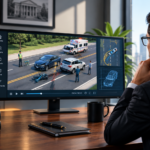
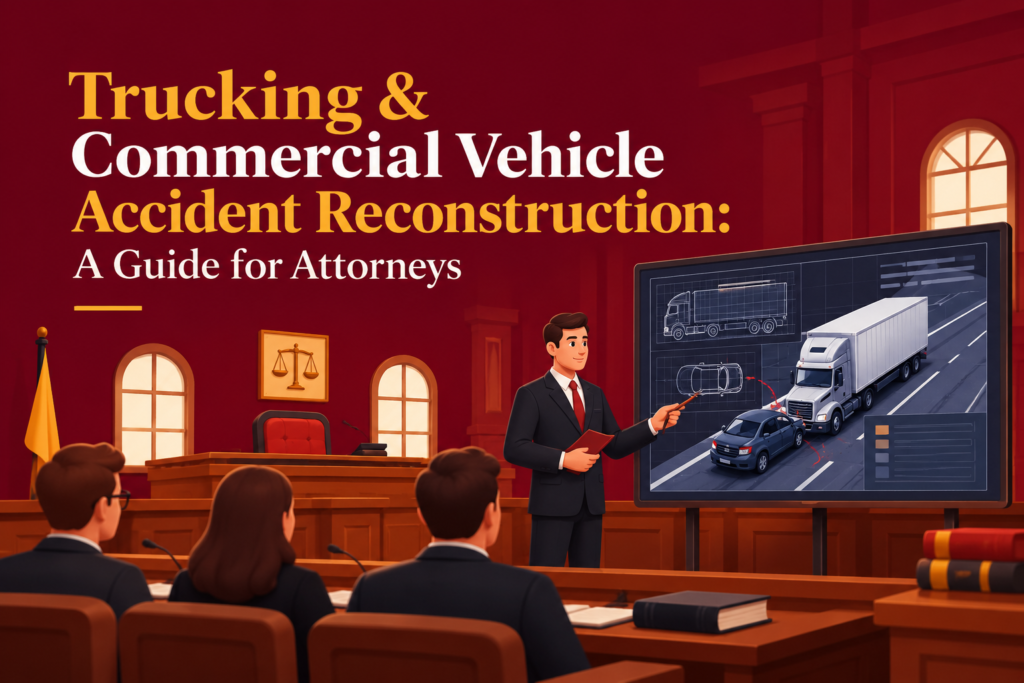
Animation shows the detailed analysis of the truck approaching, the car turning, and the impossibly short braking window. Every impact is shown, making the negligence clear.
Multiple camera angles add power. The driver’s view demonstrates visibility arguments. Overhead view shows lane positioning. The side view shows the truck’s length and stopping needs.
Truck Physics, Explained
Truck dynamics confuse jurors because they contradict car instincts. Stopping distances are longer. Trailers swing. Loads shift. Rollovers happen at speeds that seem safe.
A fully loaded tractor-trailer needs roughly twice the stopping distance of a passenger car at highway speed. Jurors who drive cars don’t believe this until they watch the animation play both scenarios side by side.
Animation makes these dynamics observable. Jurors see why the truck couldn’t stop, or how trailer momentum made the crash unavoidable once control was lost.
Timeline Compression
Trucking cases involve sequences that unfolded across minutes or hours. The driver skipped a rest stop three hours back. Dispatch pressured a delivery window. The approach to the intersection took eleven seconds.
Animation compresses these timelines into coherent sequences. The jury sees cause and effect across time in a way that testimony spread across three days of trial never achieves.
Anchoring Against Defense Confusion
Defense reconstruction experts often present competing theories designed to muddy physical reality. Your animation becomes the fixed point jurors return to while the defense tries to blur everything.
When your expert testifies alongside a synchronized reconstruction and the defense expert has only charts and words, the credibility gap is enormous.
Does Animated Reconstruction Increase Settlement Value in Trucking Accident Claims
In commercial vehicle cases, emphatically yes, and the effect amplifies compared to standard auto litigation.
Corporate Defendants Calculate Exposure
Trucking companies and carriers evaluate files based on trial exposure. Strong animated reconstruction shows liability clearly, and it shows how bad that liability looks to a jury.
These defendants know jurors hold commercial carriers to higher standards than individual drivers. Animation that pairs physical causation with regulatory violations is settlement pressure at maximum.
Small Liability Shifts, Huge Dollar Differences
Trucking cases often involve catastrophic harm. Spinal injuries, brain injuries, wrongful death. In these cases, modest liability percentage shifts translate into millions.
Animation that solidifies liability by even a small margin can change recovery by more than its cost, fifty times over.
Mediation Leverage
When defense counsel watches your reconstruction in mediation, the conversation changes. “We dispute liability” becomes “let’s focus on damages.”
Carriers facing strong visual evidence move toward limits faster, especially when the video makes their driver look reckless rather than merely unlucky.
Defense attorneys will also tell you, quietly, that animated cases are harder to advise their clients on. It’s one thing to explain exposure from a deposition transcript. It’s another to sit next to a carrier executive while a reconstruction of their driver’s last eleven seconds plays in high definition.
FAQs
What is ECM data and why does it matter so much?
The Engine Control Module records speed, braking, throttle, and fault codes in the seconds before impact. It’s often the most objective evidence of what the truck was actually doing.
How fast does ECM data disappear?
It varies by system, but overwriting can happen within days of continued operation. Immediate preservation demands are essential.
Which federal regulations apply to carriers?
FMCSA rules cover hours of service, vehicle maintenance, driver qualifications, cargo securement, and loading. Violations support negligence and sometimes punitive claims.
What does reconstruction animation cost?
Typically $10,000 to $40,000 depending on complexity. Against trucking case values, ROI is usually obvious.
Does animation help when the defense has their own expert?
Yes. Animation forces both sides to commit to specific physics and timelines. Vague theories collapse when they have to be visualized.
How long does the process take?
Plan on six to ten weeks for full reconstruction with expert review. Rush timelines exist but compress revision cycles.
Should I send a preservation letter even before deciding to take the case?
Yes. If a potential trucking case crosses your desk, send the preservation letter immediately. You can decline the case later. You can’t rebuild an overwritten ECM.
Can reconstruction animation support punitive damages arguments?
Absolutely. Animation showing conscious disregard, like a driver blowing through rest stops on a fatigued schedule, gives juries the visual narrative that supports punitive awards.
Conclusion
Trucking litigation rewards attorneys who master the evidence landscape and invest in making complex facts clear. ECM data, FMCSA rules, and scientific reconstruction form the foundation. Animation builds the structure the jury can actually stand inside.
The simple thing to remember is reconstruction shows you the truth while animation makes the truth undeniable.
At Law Animator, we build trucking reconstructions from ECM data, scene measurements, and expert analysis, delivered as trial-ready animation that holds up under Daubert review.
When you need a commercial truck accident animation company that understands both the physics and the law, we’re ready.