Legal Animation vs. Trial Graphics: What’s the Difference?

On this page

Table of Contents

Law Animation
Legal Animation vs. Trial Graphics What’s the Difference

Complex legal cases often involve a large amount of information.

Attorneys may need to explain accident sequences, medical procedures, technical processes, timelines, expert opinions, and complicated relationships between different pieces of evidence. While documents and verbal testimony remain essential, visual communication can help make complex information easier to understand.

Two commonly used litigation visuals are legal animation and trial graphics.

Although both are designed to support legal presentations, they serve different purposes.

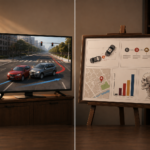
Legal animation shows how something happened over time. Trial graphics organize and illustrate information in a static visual format.

Understanding the difference can help attorneys choose the right visual strategy for mediation, arbitration, settlement presentations, trial preparation, and courtroom presentations.


What Is Legal Animation?

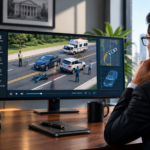
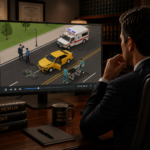
Legal animation is a 2D or 3D animated visualization used to demonstrate events, movement, processes, injuries, technical concepts, or expert opinions relevant to a legal case.

Unlike a static image, animation can show a sequence of events as it unfolds.

For example, a legal animation may demonstrate:

  • How a car accident occurred
  • The movement of vehicles before a collision
  • How a workplace accident happened
  • A medical procedure or injury mechanism
  • How a product failed
  • The sequence of events described by an expert
  • A complex engineering or technical process

Legal animation is particularly useful when movement, timing, sequence, or spatial relationships are important to understanding the case.

Example

Imagine a truck accident at an intersection.

A written report may describe where each vehicle was traveling. Photographs may show the damage after the collision.

But a 3D animation can visually demonstrate:

  1. The approach of each vehicle
  2. Their positions before impact
  3. The sequence of movement
  4. The collision
  5. The resulting motion

This makes legal animation a powerful communication tool for explaining events that are difficult to visualize from static evidence alone.


What Are Trial Graphics?

Trial graphics are visual aids designed to organize, simplify, and present information in a clear format.

Unlike animation, trial graphics are generally static.

Common types of trial graphics include:

  • Timelines
  • Charts
  • Maps
  • Diagrams
  • Medical illustrations
  • Infographics
  • Event sequences
  • Comparison charts
  • Process diagrams
  • Enlarged photographs
  • Annotated images

Trial graphics can help attorneys guide the audience through large amounts of information without requiring a complex animated production.

Example

Using the same truck accident scenario, a trial graphic might include:

  • A map of the intersection
  • Vehicle positions
  • Labels showing direction of travel
  • A timeline of events
  • A diagram identifying the point of impact

Each graphic can explain an important part of the case.


The Main Difference Between Legal Animation and Trial Graphics

The simplest way to understand the difference is:

Legal Animation shows movement and sequence. Trial Graphics organize and explain information visually.

Here is a quick comparison:

FeatureLegal AnimationTrial Graphics
FormatMoving visualStatic visual
Best forEvents and processesInformation and evidence
Shows movementYesUsually no
Shows timingYesThrough timelines or sequences
Typical examplesAccident reconstruction, medical proceduresCharts, timelines, diagrams
Production complexityOften higherOften lower
Budget requirementsCan be higherCan be more flexible
Best useComplex eventsClear presentation of facts

The two are not competitors.

In many complex cases, legal animation and trial graphics work best together.


When Should Attorneys Use Legal Animation?

Legal animation is often most valuable when the audience needs to understand something that happened over time.

Consider legal animation when the case involves:

1. Movement

Animation can show the movement of vehicles, people, machinery, equipment, or other objects.

This is especially useful for:

  • Car accidents
  • Truck accidents
  • Motorcycle collisions
  • Pedestrian accidents
  • Construction accidents
  • Workplace incidents

2. A Sequence of Events

Some events happen quickly and involve multiple stages.

Animation can help break the sequence into understandable steps.

For example:

Before the event → During the event → After the event

This can make complex accident or incident scenarios easier to follow.

3. Complex Medical Processes

Medical cases often involve anatomy and biological processes that cannot be easily seen.

Medical legal animation can help visualize:

  • Surgical procedures
  • Injury mechanisms
  • The progression of an injury
  • Medical device placement
  • Anatomical structures

4. Technical or Engineering Concepts

Legal animation can also help explain:

  • Product failures
  • Mechanical processes
  • Industrial equipment
  • Construction defects
  • Engineering failures
  • Patent technology

When movement or functionality is central to the case, animation may provide greater clarity than a static image.


When Should Attorneys Use Trial Graphics?

Trial graphics are often the right choice when the goal is to organize and simplify information.

They can be especially useful for presenting:

Timelines

Timelines help demonstrate the order of events.

For example:

  • When an incident occurred
  • When medical treatment began
  • When a product was manufactured
  • When important communications occurred

Charts and Data

Charts can help organize:

  • Financial information
  • Medical records
  • Test results
  • Comparative data
  • Expert findings

Maps and Diagrams

Maps and diagrams can help explain:

  • Accident locations
  • Property layouts
  • Construction sites
  • Building structures
  • Routes and movement paths

Medical Illustrations

A detailed medical illustration can identify:

  • The location of an injury
  • A specific bone or organ
  • Surgical areas
  • Medical devices

For straightforward information, a static visual may be faster and more cost-effective than creating a complete animation.


Legal Animation vs. Trial Graphics: Which Is Better?

Neither is automatically better.

The right choice depends on what needs to be explained.

A useful question for attorneys is:

Does the audience need to see something happen?

If the answer is yes, animation may be the better option.

Does the audience need to understand information?

If the answer is yes, a trial graphic may be enough.

For example:

Case NeedRecommended Visual
Explain how two vehicles collidedLegal Animation
Show the accident locationTrial Graphic
Demonstrate a surgical procedureMedical Animation
Show the location of an injuryMedical Illustration
Explain a product’s moving mechanismLegal Animation
Compare two product designsTrial Graphic
Show a sequence of eventsAnimation or Timeline
Present complex dataChart or Infographic

The most effective litigation presentation may combine several visual formats.


Can Legal Animation and Trial Graphics Be Used Together?

Yes—and in many cases, they should be.

Consider a personal injury case involving a vehicle collision.

A complete visual strategy might include:

Trial Graphics

  • Timeline of events
  • Map of the accident location
  • Vehicle damage photographs
  • Medical treatment timeline
  • Diagram of injuries

Legal Animation

  • Vehicle movement before impact
  • Collision sequence
  • Point of impact
  • Post-impact movement

Using different types of visuals allows each format to do what it does best.

Trial graphics can establish the facts.

Animation can demonstrate how the events unfolded.


Cost Differences Between Legal Animation and Trial Graphics

Cost can vary significantly depending on the complexity of the project.

Trial graphics are often more cost-effective because they may require less modeling, animation, rendering, and technical production.

Legal animation can require:

  • Evidence review
  • Storyboarding
  • 3D modeling
  • Texturing
  • Animation
  • Lighting
  • Rendering
  • Expert collaboration
  • Multiple review cycles

However, the decision should not be based on price alone.

The goal should be to select the visual format that communicates the necessary information as clearly as possible.

In some cases, a simple diagram may be all that is needed.

In others, a detailed 3D reconstruction may be the most effective way to explain a critical sequence of events.


Accuracy Matters in Both Formats

Whether you use animation or trial graphics, the visual should be developed carefully.

Litigation visuals may be based on:

  • Case documents
  • Photographs
  • Videos
  • Medical records
  • Accident reports
  • Expert opinions
  • Engineering data
  • Witness testimony
  • Other relevant evidence

Where a visual reflects technical analysis or expert opinions, collaboration with appropriate qualified professionals can be important.

A high-quality visual is not simply about design.

It should also be clear about what information, assumptions, evidence, and expert analysis support the presentation.


How to Choose the Right Litigation Visual

Before commissioning a visual, consider these questions:

What is the most difficult part of the case to explain?

Identify the specific issue causing confusion.

Does movement matter?

If the answer is yes, animation may be appropriate.

Is the information primarily factual or data-driven?

If so, a timeline, chart, diagram, or other trial graphic may work better.

Who is the audience?

A visual designed for an expert may look different from one designed for a jury.

What evidence supports the visualization?

The production process should begin with the available case materials and, where necessary, relevant expert analysis.

What is the goal?

Are you preparing for:

  • Mediation?
  • Settlement discussions?
  • Arbitration?
  • Expert testimony?
  • Trial?

The intended use can influence the type and complexity of the visual.


How Law Animator Helps Legal Teams Choose the Right Visual Strategy

At Law Animator, we understand that every case does not require the same type of visualization.

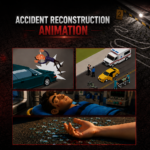
Some cases benefit from a detailed 3D accident reconstruction.

Others may require a clear timeline, medical illustration, technical diagram, or combination of different visual formats.

Our approach begins by understanding:

  • The complexity of the case
  • The available evidence
  • The information that needs to be communicated
  • The intended audience
  • The role the visual will play in the overall case strategy

From there, we help legal teams identify an appropriate visual solution.

Our services can support cases involving:

  • Accident reconstruction
  • Personal injury
  • Medical malpractice
  • Product liability
  • Construction accidents
  • Workplace incidents
  • Technical and engineering disputes
  • Complex litigation

The goal is simple:

Use the right visual to make complex information easier to understand.


Frequently Asked Questions

What is the difference between legal animation and trial graphics?

Legal animation uses movement to demonstrate events, processes, or sequences over time. Trial graphics are typically static visuals such as timelines, charts, diagrams, maps, and medical illustrations.

Is legal animation more expensive than trial graphics?

It can be. Detailed 3D animation often requires additional production work, including modeling, animation, rendering, and expert review. However, the final cost depends on the scope and complexity of the specific project.

Can trial graphics include animation?

Yes. Some presentations combine static graphics with simple motion or transitions. The distinction is not always absolute, but full legal animation is generally used when movement and sequence are central to the visual explanation.

Which is better for accident reconstruction?

If understanding vehicle movement and the sequence of events is important, accident reconstruction animation may be useful. Static diagrams and maps can also provide important context. Many cases benefit from using both.

Can legal animation and trial graphics be used in the same case?

Yes. Trial graphics can organize and present facts, while legal animation can demonstrate movement and sequence. Using both can create a more complete visual presentation.


Choose the Right Visual for Your Case

Complex legal information does not always need a complex visual.

Sometimes, a simple timeline or diagram is the clearest solution. In other cases, a detailed 3D animation may be necessary to explain how an event unfolded.

The key is choosing the format that best communicates the information your audience needs to understand.

Law Animator helps attorneys and legal teams transform complex cases into clear visual presentations—from trial graphics and demonstrative exhibits to detailed legal and accident reconstruction animations.

Contact Law Animator to discuss your case and determine the right visualization strategy for your litigation needs.

Contact Us

We usually respond within a few hours.