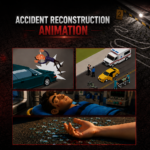
Legal cases can involve complex events, technical evidence, medical procedures, accident scenes, and expert testimony that may be difficult to explain through words alone. Legal animation helps transform complicated information into a clear visual presentation, making it easier for attorneys, jurors, judges, and other audiences to understand what happened.
From accident reconstruction to medical malpractice and product liability cases, legal animation has become an increasingly valuable form of demonstrative evidence and litigation support.
In this guide, we explain what legal animation is, how it is used in court, and why law firms use visual storytelling to communicate complex evidence more effectively.
What Is Legal Animation?
Legal animation is the use of 2D or 3D animation to visually demonstrate events, processes, injuries, accidents, or technical concepts relevant to a legal case.
Depending on the case, an animation may help illustrate:
- How a vehicle accident occurred
- The sequence of events leading to an injury
- A medical procedure or alleged medical error
- The mechanics of a product failure
- A construction or workplace accident
- A patent, engineering, or technical process
- Scientific or forensic evidence
A legal animation is typically developed using information and evidence provided by the legal team and relevant experts. This may include photographs, videos, medical records, accident reports, engineering data, deposition testimony, expert opinions, measurements, diagrams, and other case-specific materials.
The purpose is not simply to create an impressive visual. A well-developed legal animation should help communicate a case theory or explain complex evidence in a way that is easier to understand.
How Is Legal Animation Used in Court?
Legal animation can be used at different stages of litigation and trial preparation. Attorneys may use visual demonstrations to help explain complicated facts, prepare witnesses, support expert testimony, or present information to a jury.
1. Explaining Accident Reconstruction
One of the most common uses of legal animation is accident reconstruction.
In a motor vehicle accident, for example, multiple factors may need to be explained, including:
- Vehicle speed and movement
- Points of impact
- Road layout
- Driver actions
- Visibility
- Timing and sequence of events
- Vehicle positions before and after a collision
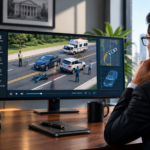
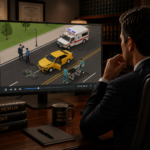
Rather than relying only on verbal testimony, an accident reconstruction animation can visually demonstrate how experts believe an event occurred based on the available evidence and analysis.
This can be particularly useful in complex car, truck, motorcycle, pedestrian, aviation, or workplace accident cases.
2. Demonstrating Medical Injuries and Procedures
Medical evidence can be difficult for people without a clinical or scientific background to understand.
A medical legal animation may be used to demonstrate anatomy, injuries, surgical procedures, or the progression of a medical condition.
For example, animation may help explain:
- Traumatic brain injuries
- Spinal injuries
- Birth injuries
- Surgical procedures
- Medical device failures
- The physical impact of an accident
- Alleged medical errors
By turning complex medical concepts into a visual sequence, attorneys and medical experts may be able to present information in a clearer and more understandable format.
3. Supporting Expert Testimony
Experts often play an important role in complex litigation. However, expert testimony may involve technical language, calculations, scientific principles, or processes that are difficult for a jury to visualize.
Legal animation can support expert testimony by providing a visual representation of the expert’s analysis or opinion.
For example, an engineering expert may explain how a structural failure occurred. A forensic expert may explain the sequence of an incident. A medical expert may describe how an injury affected a specific part of the body.
The animation can help provide visual context while the expert explains the underlying evidence and methodology.
4. Simplifying Complex Evidence
Some legal cases involve hundreds or thousands of pages of documents, technical reports, diagrams, photographs, and data.
A carefully developed animation can help organize certain aspects of that information into a visual narrative.
Instead of asking a jury to imagine an event, the presentation can help illustrate:
What happened → How it happened → Why it matters
This approach can be especially useful in litigation involving complex technical, medical, engineering, or scientific evidence.
Legal Animation vs. Trial Graphics: What Is the Difference?
Legal animation and trial graphics are both visual litigation tools, but they are not the same.
Trial graphics are generally static visuals such as:
- Timelines
- Charts
- Maps
- Diagrams
- Medical illustrations
- Infographics
- Enlarged photographs
Legal animation, on the other hand, introduces movement and sequence. It can demonstrate how events unfolded over time.
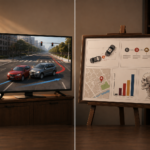
For example, a trial graphic may show the positions of two vehicles at the moment of impact. A legal animation can show the vehicles moving toward the collision and demonstrate the sequence of events.
In many cases, attorneys may use both animation and trial graphics as part of a broader litigation presentation strategy.
What Types of Cases Can Use Legal Animation?
Legal animation can be adapted for a wide range of cases.
Personal Injury Cases
Personal injury attorneys may use animation to explain how an accident occurred and how the event caused an injury.
Examples include:
- Car accidents
- Truck accidents
- Motorcycle accidents
- Pedestrian accidents
- Slip and fall incidents
- Workplace accidents
Medical Malpractice Cases
Medical animations may help explain procedures, anatomy, treatment decisions, injuries, and alleged deviations from an accepted standard of care.
Product Liability Cases
When a product allegedly fails or causes an injury, animation can help demonstrate how the product works, how the failure occurred, and the sequence of events that followed.
Construction and Workplace Accident Cases
Complex construction sites and industrial environments can be difficult to explain through photographs alone.
Animation may help reconstruct equipment movement, site conditions, safety procedures, or the events leading to an accident.
Patent and Intellectual Property Litigation
Patent and intellectual property disputes can involve complicated products, systems, processes, and technologies.
3D visualization and animation can help explain how a technology works in a more accessible way.
How Is a Legal Animation Created?
The process typically begins with a review of the available case materials.
Depending on the project, the production team may work with:
- Attorneys
- Accident reconstruction experts
- Medical professionals
- Engineers
- Forensic specialists
- Other qualified subject-matter experts
The general process may include the following stages.
Evidence Review
Relevant documents, reports, images, videos, measurements, and expert materials are reviewed to understand the facts and requirements of the project.
Research and Expert Collaboration
Where appropriate, the animation is developed around expert analysis, testimony, technical information, or other case-supported evidence.
Storyboarding
Before animation begins, the sequence of events and visual presentation may be mapped out through storyboards or preliminary visual concepts.
3D Modeling and Animation
Objects, environments, anatomy, vehicles, equipment, or other relevant elements are modeled and animated.
Review and Revision
Attorneys and relevant experts review the work to help ensure that the presentation accurately reflects the intended evidence, assumptions, or expert opinions.
The exact workflow depends on the complexity and requirements of the case.
Are Legal Animations Used as Evidence in Court?
The treatment and admissibility of legal animations can depend on the jurisdiction, purpose of the animation, applicable rules of evidence, and the specific circumstances of the case.
For this reason, attorneys should evaluate legal animations based on their own case strategy and applicable legal requirements.
In general, it is important to clearly understand whether an animation is being used as a demonstrative aid, an illustration of expert opinion, a reconstruction, or for another evidentiary purpose.
A legal animation should also be based on reliable case materials, documented assumptions, and appropriate expert input when necessary.
Legal professionals should make decisions regarding admissibility and courtroom use in consultation with qualified counsel and relevant experts.
Why Does Visual Storytelling Matter in Litigation?
Jurors are often asked to understand events that they did not personally witness.
They may need to evaluate complex testimony, technical reports, medical terminology, engineering principles, and competing versions of events.
Visual communication can help organize information and provide context.
A strong legal animation does not replace evidence or expert testimony. Instead, it can serve as a visual communication tool that helps audiences better understand the information being presented.
The goal is clarity.
When complex information is presented in a structured and visually understandable way, attorneys may find it easier to explain their case narrative and connect individual pieces of evidence.
What Should Attorneys Look for in a Legal Animation Company?
Not every animation studio is designed to work with litigation-related projects.
When selecting a legal animation provider, attorneys may want to consider:
Experience With Legal and Technical Subject Matter
Legal cases often involve detailed evidence and highly technical information. The production team should be comfortable working with complex materials and collaborating with legal and technical professionals.
Accuracy and Attention to Detail
Visuals should be developed carefully around the available evidence, assumptions, expert analysis, and project requirements.
A Clear Review Process
Attorneys and relevant experts should have opportunities to review the work throughout the production process.
Ability to Explain Complex Information
The goal is not just high-quality animation. The visual should communicate information clearly to its intended audience.
Litigation-Focused Experience
Experience with courtroom presentations, demonstrative evidence, accident reconstruction, medical visualization, and other legal applications can be valuable when developing case-specific visuals.
How Law Animator Helps Bring Complex Cases to Life
At Law Animator, we focus on transforming complex legal, technical, and scientific information into clear visual experiences.
Our work can support attorneys and legal teams across a range of litigation matters, including accident reconstruction, personal injury, medical malpractice, product liability, construction accidents, and complex technical cases.
Our approach begins with understanding the case.
We work with the available materials and collaborate with attorneys, experts, and relevant professionals throughout the visualization process. Every project is approached with the goal of creating a clear, professional, and case-focused visual presentation.
Whether the objective is to demonstrate how an accident occurred, explain a medical injury, visualize a technical process, or support expert testimony, our team helps turn complex information into visuals that are easier to understand.
Frequently Asked Questions About Legal Animation
What is the purpose of legal animation?
Legal animation is used to visually explain events, evidence, injuries, processes, or expert opinions that may be difficult to communicate through words, documents, or static images alone.
Who uses legal animation?
Legal animation may be used by attorneys, law firms, expert witnesses, accident reconstruction specialists, medical professionals, engineers, and litigation teams.
What types of cases use legal animation?
Legal animation can be used in personal injury, accident reconstruction, medical malpractice, product liability, construction accident, patent, intellectual property, and other complex litigation matters.
How long does it take to create a legal animation?
The timeline depends on the complexity of the project, the amount of available evidence, the level of detail required, expert review, and revision requirements.
Is legal animation the same as accident reconstruction?
No. Accident reconstruction animation is one type of legal animation specifically focused on demonstrating how an accident may have occurred based on available evidence and expert analysis.
Can legal animation help explain expert testimony?
Yes. Legal animation can be used as a visual communication tool to help illustrate complex technical, medical, engineering, or scientific concepts discussed by qualified experts.
Final Thoughts
Legal animation has become a powerful communication tool for cases involving complex events and evidence.
From reconstructing accidents to explaining medical injuries and technical processes, animation can help transform complicated information into a visual format that is easier to follow.
However, the effectiveness of a legal animation depends on more than visual quality. Accuracy, evidence, expert collaboration, clear communication, and a structured production process are all important.
For attorneys handling complex litigation, the right visual strategy can help make difficult information more understandable.
Law Animator helps legal teams turn complex cases into clear, compelling visual stories. Explore our legal animation services to see how accident reconstruction, medical animation, courtroom visualization, and other litigation-focused visuals can support your next case.